
A boy falls down in the middle of a lesson. His body stiffens, then shakes. Froth gathers at his mouth. The class scatters. By evening the whole village has an explanation, and it is not a medical one. Someone in that family must have done something.
If you have grown up anywhere in Uganda, you have heard this. In the village, in the taxi, in the staff room, sometimes in church. It is one of the most widely held beliefs about epilepsy in this country, and it is the reason many families never reach a health facility at all.
The myth
Epilepsy is caused by witchcraft, a family curse, or evil spirits. The answer is the healer, the shrine, or prayer and fasting — not the clinic.
How common is this belief, really?
Common enough that researchers have measured it repeatedly. Duke University’s Uganda epilepsy programme, working with Ugandan investigators, found that around two-thirds of Ugandans believe seizures may be caused by spiritual influences — ancestral forces, witchcraft, or possession. A review of stakeholder studies in Uganda found supernatural explanations for epilepsy present in 66 to 72 percent of the groups examined.
So this is not a fringe idea held by a few people in a far village. It is the mainstream explanation in much of the country.
16.9
people in every 1,000 in Uganda live with epilepsy — roughly 1 in 60. Highest in the 20–39 age group.
2 in 3
Ugandans believe seizures may be caused by spiritual forces such as witchcraft, possession or ancestral influence.
66–79%
of Ugandans with epilepsy are not receiving proper treatment. Some studies put this figure even higher.
Where the belief comes from
It is not stupidity, and it did not start in Uganda. A seizure is frightening to watch. A person drops without warning. The body moves in ways nobody can control. Then they wake up and remember nothing. For most of human history, no one anywhere could explain that. A spiritual explanation was the only one available.
There is also a practical reason families go to healers, and it has nothing to do with belief. Uganda has roughly one doctor for every 20,000 people. Traditional healers are estimated at one for every few hundred. When your child is convulsing at nine in the night in a village two hours from the nearest health centre III, the healer is who is actually there.
What actually happens in a seizure
The brain works on electrical signals. Brain cells talk to each other by firing tiny electrical impulses in an organised rhythm. In epilepsy, a group of those cells sometimes fires all at once, in a sudden disorganised burst. A seizure is what that burst looks like from outside the body.
The known causes in this region are ordinary medical ones. A difficult birth. Severe malaria or meningitis affecting the brain in childhood. Head injury, including boda boda accidents. Neurocysticercosis, a tapeworm infection linked to pig-keeping, which is part of why some districts carry a much heavier burden than others. Stroke in older adults. Sometimes a genetic difference. Often no cause is ever identified.
Ugandan research backs this up directly. A population study in Iganga and Mayuge screened over 64,000 people and found that in children, epilepsy was strongly associated with problems during pregnancy and with trouble feeding, crying or breathing in the first days of life. Not with anything the family did. With what happened around the birth.
And epilepsy is not contagious. You cannot catch it by touching someone who is seizing, by their saliva, or by sharing a plate or a mat with them.
The part that matters most: where the family goes first
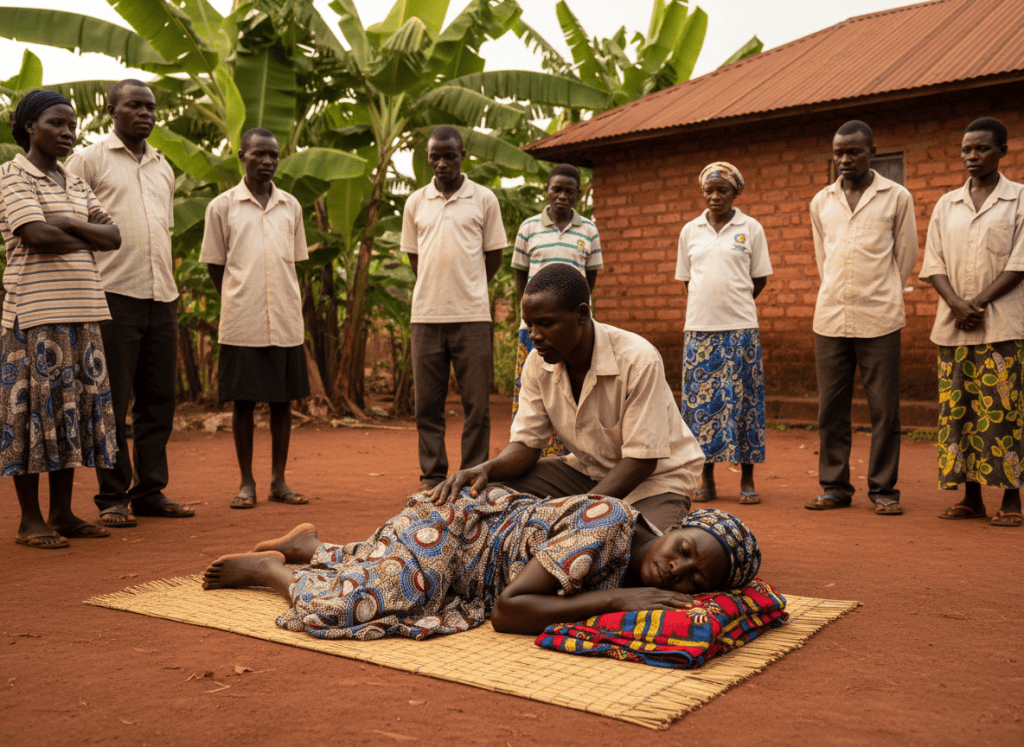
This is where the myth stops being just a belief and starts costing people their health.
Researchers from Duke and Ugandan institutions followed people with epilepsy attending Mulago, Butabika and other public hospitals, and asked a simple question: where did you go first, and what happened to your seizures? The pattern in their findings is hard to argue with.
| Outcome | Went to traditional healer first | Went to faith healer first | Went to a health facility first |
|---|---|---|---|
| Seizures stopped completely | 4.3% | 2.2% | 12.3% |
| Seizures became less frequent | 10.8% | 10.9% | 42.1% |
| No change at all | 83.1% | 80.4% | 31.8% |
Read the bottom row again. Four out of five people who went to a healer first had no change in their seizures. Among those who went to a health facility first, that figure dropped to about one in three.
The same research found that going to a traditional healer first delayed arrival at medical care by close to 17 months. Almost a year and a half of seizures that could have been treated. And in that same body of work, 37 percent of people had gone to a traditional healer first and another 7.5 percent to a faith healer.
In the Iganga and Mayuge study, only about 21 percent of people identified with epilepsy were taking anti-seizure medication, while nearly half had used traditional medicines. Almost 70 percent did not know they had a diagnosable, treatable condition at all.
What the delay actually costs
- Money that goes to ceremonies, herbs and repeat visits instead of medication that costs a fraction of it.
- Children pulled out of school, or never sent, because a teacher or a parent decides there is no point.
- Burns from cooking fires and charcoal stoves, and drownings at the well or the lake, because people nearby are too afraid to touch someone who is seizing.
- Young adults told not to marry, refused work, or pushed out of family land.
- And the heaviest part: the person starts to believe it themselves. That they are cursed. That something is owed. That there is nothing to be done.
Against all of that, here is the fact that should make everyone angry: with consistent treatment, around 70 percent of people with epilepsy can achieve good seizure control. Most of the suffering described above is preventable.
This is not faith versus medicine
We want to be very clear here, because this is usually where the conversation breaks down and people stop listening.
Challenging this myth is not an attack on anyone’s faith, and it is not a claim that pastors, imams and traditional healers are the enemy. In most Ugandan communities they are the first person a worried family talks to, long before any health worker hears about the case. That access is something no clinic in this country currently has.
Which makes them one of the most powerful allies epilepsy care could have. A religious or traditional leader who understands that epilepsy is a brain condition can say something to a family that a stranger in a white coat cannot: this child is not cursed, your family has done nothing, now take him to the health centre. Pray, and take the medication. Those have never been opposites.

So what should you actually do?
- If someone in your family has seizures, take them to a health facility. It is a medical condition and it responds to treatment. Going early changes the outcome.
- Once treatment starts, the medicine is taken every single day — including on days with no seizures, and including after months of doing well. Stopping because things improved is one of the most common reasons seizures come back.
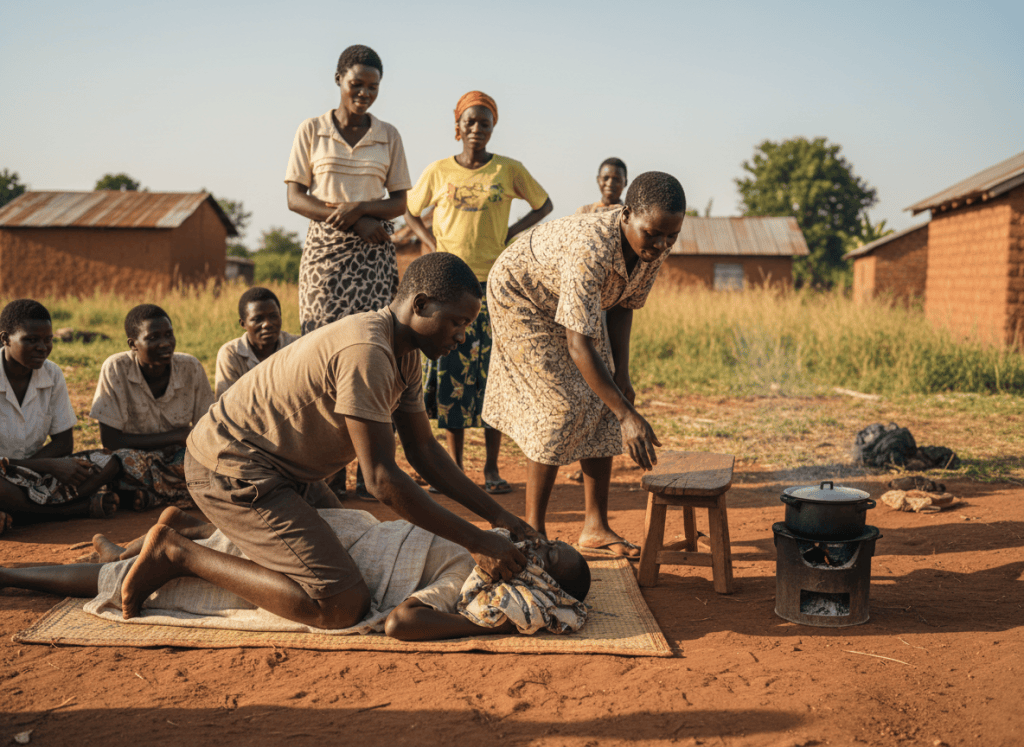
- If someone is seizing near you, help them. Move away fire, water, sharp things and furniture. Put something soft under the head. Turn them on their side. Time it. Stay until they are fully awake.
- Never put anything in the mouth. Not a spoon, not a stick, not your fingers. A person cannot swallow their tongue, and this causes broken teeth and bitten fingers.
- Get to a hospital urgently if the seizure goes past five minutes, if another starts before they wake up, if they are injured, or if it is their first ever seizure.
- If you hear a child called cursed, say something. That one sentence is often where a much smaller life begins.

Now I understand
Knowing that epilepsy is a condition of the brain is where this starts. Understanding is what comes after: that this family is not guilty of anything, that this child belongs in a classroom, and that the person on the ground is someone to help rather than someone to fear.
Awareness shouldn’t end with “I know.” It should begin with “Now I understand.”
#FromIKnowToNowIUnderstand
Where these figures come from
- Kakooza-Mwesige A. and colleagues. Population-based prevalence of epilepsy in Uganda: a nationwide cross-sectional survey. Epilepsia, 2025. (16.9 per 1,000; highest burden in the 20–39 age group.)
- Kakooza-Mwesige A. and colleagues. Adverse perinatal events, treatment gap, and positive family history linked to the high burden of active convulsive epilepsy in Uganda. Epilepsia Open, 2017. (Iganga/Mayuge population study: 21.2% on medication, 49.3% using traditional medicines, ~70% unaware of diagnosis.)
- Duke Global Neurosurgery & Neurology with Makerere University: research on barriers to biomedical care for people with epilepsy in Uganda. (First point of care, 16.8-month delay, and seizure outcomes by care pathway.)
- Duke Department of Psychiatry & Behavioral Sciences, reporting on countrywide survey work on Ugandan beliefs about seizures. (Two-thirds attributing seizures to spiritual influences; provider-to-population ratios.)
- Community perspectives and recommendations to reduce epilepsy stigma and enhance effective management of epilepsy in Uganda: a qualitative study, 2025. (Treatment gap of 66–79%; ~70% achieving good control with treatment.)
ACE — Awareness Changes Everything is a mental health awareness organisation. We share information and reduce stigma; we do not diagnose, prescribe or provide emergency treatment. If you or someone you know is having seizures, please see a qualified health worker at your nearest health facility.


Leave a comment